
Frequently Asked Questions
Q.) Is there anything to check after installing the new carburetor?
A.) Yes you should always check your wide open throttle. To check; please floor the gas pedal from inside the vehicle, and make sure to open slowly. Once the pedal is against its stop, or stops moving, please check the position of your throttle plates to ensure both the front and rear are fully open. Last please confirm that the foot pedal stop is what stops the wide open sequence, and ensure the foot pedal stop is engaged slightly before the carburetor stop.
Q.) How much room do I need above my carburetor to my hood scoop?
A.) We recommend a minimum of 2 ½” of clearance from the tip of the vent tube to the hood.
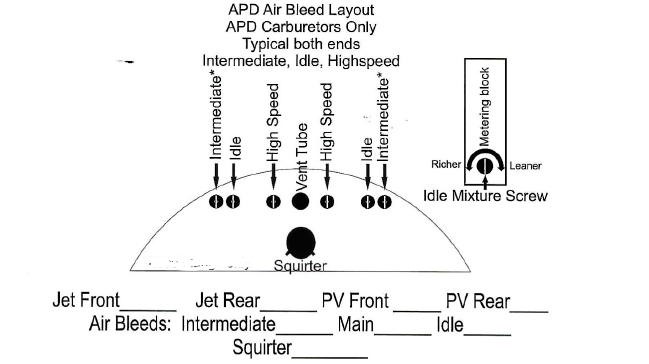
Q.) What is the air bleed layout on an APD Carburetor
A.) See picture below for visual reference: (Blank Jet Card can also be found below: Instruction Sheets & Other Resources
Q.) Do I need to make any adjustment to my floats?
A.) No; the floats are preset and should not need to be adjusted as long as the idle fuel pressure is adequate for the combination.
Q.) What is the best way to adjust the idle speed on the carburetor?
A.) Idle will be preset, and should be close. If you need to adjust idle speed; make sure to adjust both the primary and secondary idle adjustment screws equally.
Q.) What is the bowl inlet thread on an APD Billet Fuel Bowl?
A.) Thread size is ¾-16 (#8AN) O-ring, and we stock them in -6 male, -8 male and -8 female for a fuel log.
Q.) Can an APD fuel pump be mounted on both the driver and passenger side of the vehicle?
A.) Yes it can mount on either side, but the belt drive fuel pump will only “move” fuel when mounted on the correct side of the vehicle.
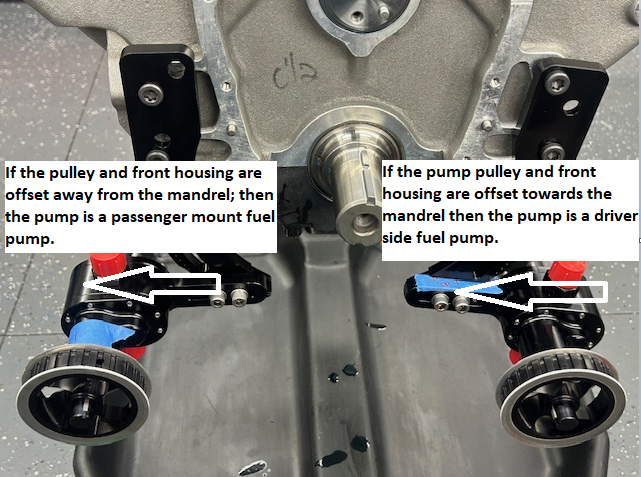
Q.) How can I tell which way my fuel pump is oriented? (Drive vs Passenger Side Mounting)
A.) Please see the picture below to help identify whether your fuel pump needs to be mounted on the driver or passenger side of the vehicle.
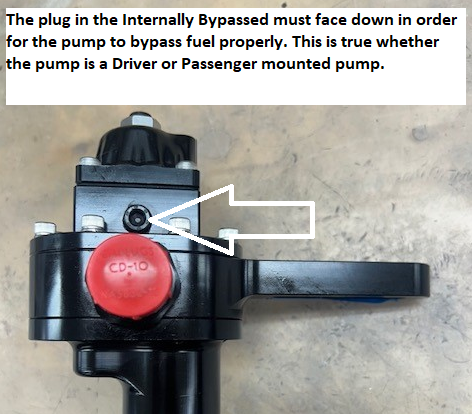
Q.) How can I tell if my Internally Bypassed Fuel Pump is setup or mounted correctly?
A.) The mounting will be the same as the external fuel pump. If the pulley offset is away from mandrel then it is a passenger side pump. If the pulley is offset towards the mandrel then it would indiciate the fuel pump mounts on the driver side. However, we need to ensure the Pipe Plug in the Internally Bypassed fuel pump is facing down towards the ground regardless of the side it is mounted on.
Q.) Can I use my Holley™ jets in an APD Carburetor?
A.) Yes, but there is a difference in the numbering system for a Holley™ Gas Jet to an APD Gas Jet. Please use the conversion chart for reference of converting Holley™ Gas Jets to APD Gas Jets. While the numbering system is different; the jet thread should be the same for gas (1/4-32), and alcohol (5/16-32) main jets. All Alcohol jets are labeled by the orifice size.

Q.) What fuel pressure do I need to have with my carburetor?
A.) This will depend on a few different variables such as type of fuel, power adders, and pump size.
*If electric fuel pump we would recommend 7lbs for Gas, and 8lbs for e85 & Alcohol
*If belt driven we would recommend 7-8lbs for Gas, 8-9lbs for e85, and 9-10lbs at Wide Open Throttle for Alcohol on N-A applications. (Needs to be set at wide open throttle above 4300 rpm. Please perform this test with the vehicle on a warm up stand to ensure safety.)
*Blow Thru and Blown combinations will require more fuel pressure. Please call 419 855-3073 for recommendations on fuel pressure for these applications.
Q.) There are a lot of options on the website to choose from; what parts do I need to rebuild my carburetor?
A.) To verify the internal parts on your carburetor please call 419 855-3073, and when calling please make sure to have your carburetors Serial Number ready. (*On a billet carburetor the serial number can be found below the front or rear fuel bowl, and is etched into the main body. Typically, they will start with a # sign and are followed by a 5-digit number.)
Q.) My car has a slight hesitation when I try to go on the transbrake. What should I do?
A.) Typically this is an indication of a lean idle circuit. To fix the hesitation please turn your mixture setting screws out slightly (counter clockwise); which is going to provide more idle fuel and should fix the stumble. (*1/2 of a turn on all 4 mixture setting screws for Alcohol, up to 3 ½ turns out.)
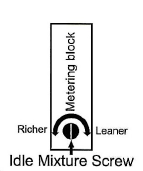
Q.) What if my stumble is still there after I richen up the mixture setting screws?
A.) If the mixture setting screw does not resolve the stumble, please reach out to APD at 419 855-3073. There are multiple reasons why a carburetor can stumble such as the accelerator pump arm gap, squirter size, transfer slot exposure, lean spike in the intermediate circuit, etc.
Q.) What is the working range of the mixture setting screws?
A.) The APD Mixture setting screws minimum setting is ¾ of a turn out from tight, and the maximum setting is 3 ½ full turns out from tight. If we get to either of these settings then we will want to make an adjustment to the idle air bleed.
Q.) My carburetor is a few years old now, and I was curious how often I should have it rebuilt?
A.) The rebuild timeframe will really depend on the maintenance performed on the carburetor over time, and the fuel type being used. If the carburetor is an Alcohol, or Oxygenated Race Gas, carburetor then we would recommend annual rebuilds due to the corrosiveness of the fuels. E85 is a little more forgiving, and with good maintenance, we would recommend a rebuild every 2 years. Race Gas is the most forgiving, and with proper maintenance we would recommend a rebuild every 3 years.
Q.) Do I need to do anything to my carburetor between races?
A.) Yes & No. If the carburetor is a Gas or E85 carburetor then you should be fine leaving it sit. However, if you are going to let the car sit for more than a month; we would recommend draining out the E85 and introducing either gas or a penetrating solution. If the carburetor is an Alcohol carburetor then we would recommend draining the fuel out of the carburetor, and introducing either gas or penetrating solution if the car will sit for more than 1 week.
Q.) What is a good winterization procedure?
A.) A good winterization procedure would be to flush both the carburetor, and the fuel system with gas to help lubricate the seals, orings, etc. Once finished please make sure to drain out the gas, blow dry, and cover for storage. If you want to use Marvel Mystery Oil, or 2 Stroke Oil, please make sure to dilute the solution with gas at a 50/50 mix.
Instruction Sheets & Other Resources
Carburetor Tuning Videos
Have a suggestion on something to add to our FAQ’s, or just a followup question? Please feel free to send us a quick message below.